


Act I: First-Principles Anchoring
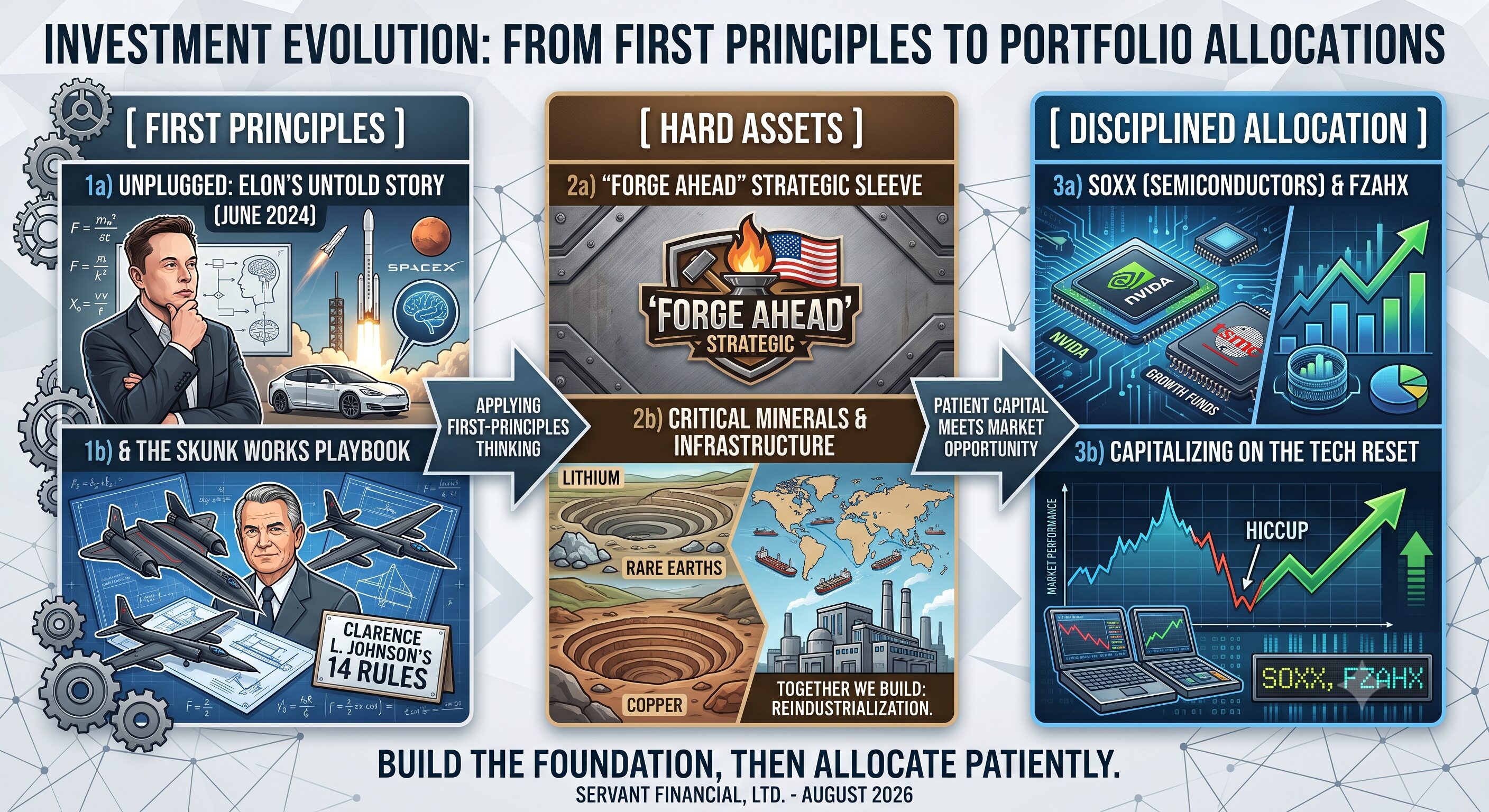
In June 2024, I wrote an article entitled Unplugged: Elon’s Untold Story. At the time, it was an exploration into the operational mindset of an innovative technologist who consistently bends industry consensus to his will. Looking back, that article marked a fundamental pivot in how we at Servant Financial analyze markets, macro themes, and capital allocation decisions.
To study Elon Musk is to realize he sits at the center of a much broader intellectual ecosystem. History offers few direct parallels, but perhaps the most fitting is Clarence “Kelly” Johnson, the legendary founder of Lockheed Martin’s Skunk Works. Kelly gained prominence by designing the Hudson Bomber for the British Air Ministry in 1938 in the days leading up to World War II.
Johnson didn’t just design revolutionary aircraft like the Hudson Bomber and the SR-71 Blackbird; he created an intellectual node—a culture governed by strict adherence to physics, extreme velocity, and a total rejection of corporate bureaucracy. The legendary SR-71 Blackbird was designed in secret in the 1960s by Kelly’s Skunk Works. The Blackbird was a Mach 3+ strategic reconnaissance aircraft which cruised at 85,000 feet and speeds over 2,200 mph. It outran every single missile fired at it.
Musk operates as a modern-day Kelly Johnson. But the real story is the network of “first-principles disciples” in his orbit—operators like Antonio Gracias at Valor Equity Partners. Musk’s disciples don’t just execute orders; they absorb Musk’s physics-based, first-principles mindset, operationalize it on factory floors, and apply it across private equity, manufacturing, and sovereign supply chains.
When you evaluate the world through this lens, you begin to evaluate companies and their business strategies by more than financial metrics alone. You begin to contemplate engineering-based supply-chain questions like: What fundamental physical inputs, energy, and hardware are required to make a future autonomous, age of abundance possible?
The Spark of Ethos
True first-principles thinking, however, requires more than technical intelligence; it demands an inviolable anchor. As the ancient wisdom of Sirach reminds us, a disciplined mind focused on what is good, true, and beautiful provides both inner strength and outward inspiration. That inner spark is the grand ethos behind some of our generation’s most audacious missions:
- Tesla:“To build a world of amazing abundance.”
- SpaceX:“To make life multi-planetary.”
- Neuralink:“To create a generalized brain interface to restore autonomy to those with unmet medical needs today and unlock human potential tomorrow.”
We saw this exact spirit when Musk co-founded OpenAI in December 2015, establishing its original charter: “to advance digital intelligence in the way that is most likely to benefit humanity as a whole, unconstrained by a need to generate financial return.”
When an organization is driven by a disciplined, transcendent mission, it transforms engineering from mere commercial utility into a force for human flourishing. And as investors, grounding our thesis in these foundational truths gives us the conviction to look past short-term market noise, focus on hard physical realities, and allocate capital behind transformational engineering paradigms.
Act II: Following the Supply Chain
Following this intellectual line of sight naturally pulled us away from pure software and toward the physical realities of scaling transformational technologies. In early 2025, we explored the frontier of automation (Will 2025 Be the Year of Autonomy?), but it quickly became obvious that autonomous fleets, AI data centers, and advanced robotics were careening toward a massive bottleneck in the physical world.
That realization inspired our April 2025 piece, Together We Build: Reindustrialization of America, modeled on the industrial mobilization of World War II. The digital backbone of high tech cannot exist without hard assets. You cannot build artificial intelligence (AI), modern defense systems, or renewable energy grids without securing the raw materials at the base of their supply chains.
This led directly to the creation of our Forge Ahead strategic sleeve and a year-long deep dive into critical resources:
- Strategic Materials: Rare Earths & Lithium (May 2025)
- Critical Materials: Cobalt, Graphite & Aluminum (June 2025)
- Essential Materials: Steel, Copper & Cement (July 2025)
During this period, we maintained a more reserved stance on technology equities as we remained significantly underweight relative to S&P 500 benchmarks. While we recognized early on that cloud hyperscalers held fulcrum positions through distribution and capital resource advantages for AI, technology valuations appeared stretched for perfection and traded more on promises rather than clear execution capabilities and confirmatory commercial activity. Likewise, we identified Semiconductors as a first order Strategic Mineral along with Rare Earths and Lithium in our pioneering Together We Build article but lacked a fundamental understanding of the sector and its growth potential at that time. Guided by first-principles discipline, we tabled any increases in technology allocations and chose to build the portfolio’s “bedrock” foundation through strategic real assets, while waiting patiently for the market dynamics to provide a structural margin of safety.
Act III: Patient Execution — Silicon Meets the Physical Grid
We felt that a margin of safety arrived over the last few months as market volatility created a timely reset in tech valuations, allowing us to move decisively to complete the portfolio’s structural arc.
Earlier this month, we initiated new allocations into tech exposure across client portfolios through a 2/3rd and 1/3rd positions in two new funds while reducing a position in a fundamental, value-oriented fund that had a run of positive performance:
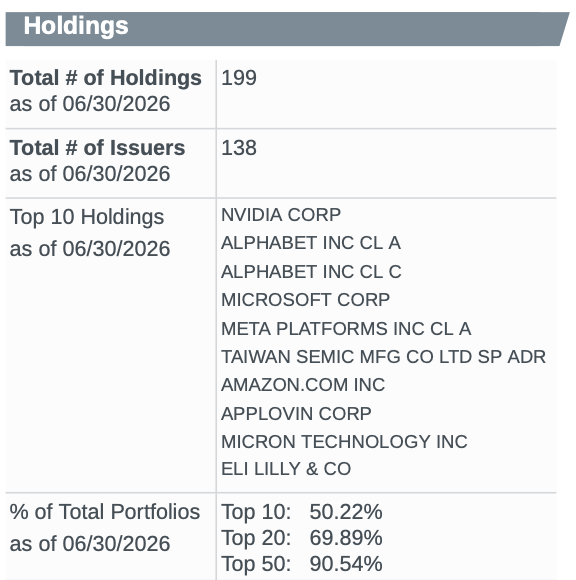
- Fidelity AI Growth Opportunities Fund (FZAHX): Capturing high-conviction growth across the leading software, hardware, and infrastructure innovators scaling the AI ecosystem. FZAHX has a Morningstar 4-star fund rating. Its fact sheet summary of holdings (subject to change) is as follows:
- iShares Semiconductor ETF (SOXX): Securing direct exposure to the fundamental silicon layer—the physical processors that power every layer of compute and autonomy – both Software and/or Agentic AI – large language models (LLMs) – and Physical AI – autonomous vehicles, robots, satellites and drones. SOXX fact sheet summary of holdings (subject to change) is as follows:
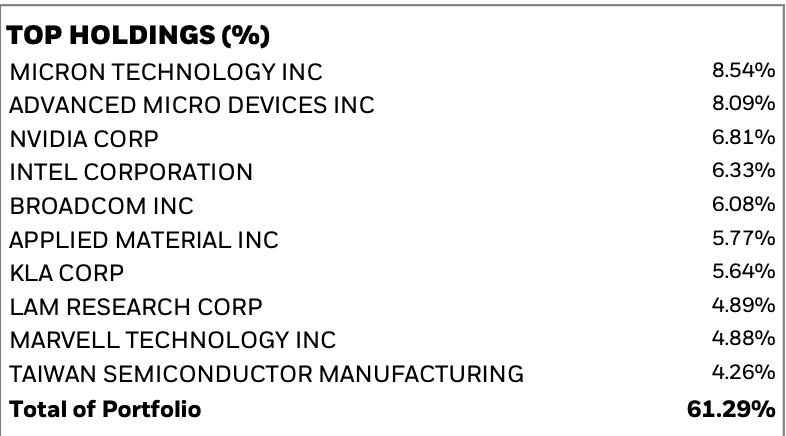
You’ll note that these funds are clearly focused on the more, hard asset-based infrastructure, like cement, steel, silicon, and related advanced manufacturing capabilities, rather than the software-based model-makers.
The Bottom Line
Our journey over the past two years—from analyzing first-principles leadership in Unplugged, to building a hard-asset base in Forge Ahead, to executing on discounted semiconductor platforms today—reflects a single, unifying philosophy: You cannot build the digital and autonomous future without first securing the physical layer that turns silicon into intelligence and intelligence into an abundant future for humanity. Servant Financial client portfolios are now positioned for the full stack Reindustrialization of America.