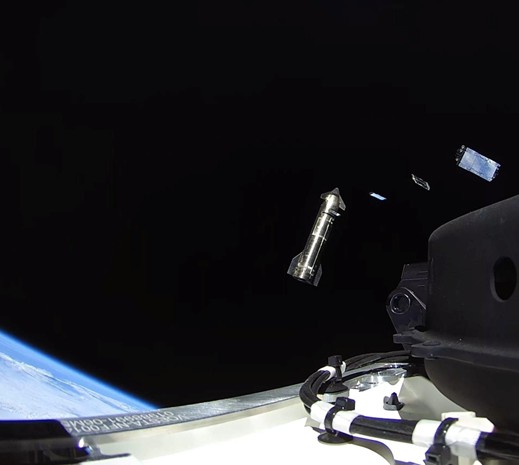


Starship #14 Deploying Starlink V3 Satellites
As we have written since April 2025, the case for the reindustrialization of America begins with strategic and critical materials for which a country should not depend on the kindness of other nations, particularly a strategic rival like China. As described in the book Freedom’s Forge, William Knudsen’s Office of Production Management sorted World War II wartime inputs by what they meant for national defense, for economic stability, and for supply-chain vulnerability. Strategic meant critical to defense and heavily dependent on a foreign source. Critical meant vital, and vulnerable. Essential meant important, with a supply chain that was comparatively stable. Our Forge Ahead minerals sleeve applies the same three layers: rare earth elements, semiconductors, and lithium; cobalt, graphite, and aluminum; steel, copper, and cement.
Sand becomes silicon, and silicon becomes intelligence. Lithium becomes storage. Steel becomes the structure of a space vehicle that seeks to Forge Beyond. The most dominant customer at the top of that American supply chain is SpaceX. It is not a second thesis. It is the same thesis, carried up the stack, to the buyer at the top of the supply chain.
SpaceX already leads two strategic markets: space launch and satellite communications. In 2025, SpaceX flew 170 of the world’s 329 orbital launches, and Starlink represents about two-thirds of every active satellite in orbit. They are strategic businesses that SpaceX dominates, and the U.S. Department of War uses them. Through September 30, 2026, SpaceX completed 113 launches this year, carrying 1,517 metric tons to orbit, and Starlink counted 13.6 million consumer subscribers and was active in 174 markets. A country that can put mass into orbit, and keep a network overhead, has an operating capability above and beyond all other economic rivals.
SpaceX’s next layers are orbital compute, chips, and solar. These businesses are strategic in Knudsen’s parlance. SpaceX does not lead them yet. We are not saying SpaceX is already a U.S. chip or solar manufacturer; far from it. Social Capital’s SpaceX deep dive is candid on this point: “Today, zero orbital data centers exist, so there is no way to say who will do it best” (p.113), and it cites a rival also cracking rocket reusability, China’s Qianfan satellite constellation, cheaper ground power, and an AI demand plateau among the key risks (p.116).
SpaceX’s iterative engineering process for orbital compute is expected to begin next year and will likely follow a similar path as Starlink’s. On September 28, 2026, Starship Flight 14 put 26 Starlink V3 satellites into orbit. SpaceX’s third-quarter report calls Flight 14 its first orbital Starship flight and its first revenue-generating Starship mission, adding about 10 times the downlink capacity of a Falcon 9 Starlink launch. Each V3 is specified at 1 Terabit per second of downlink and 160 gigabits per second of uplink, more than 10 times the downlink of a V2 Mini.
Chip and solar manufacturing will supply this future North Star orbital compute position. That last step stays honest only if the technology layers stack.
The ground game: compute, chips, and the network overhead
Before compute goes to orbit, SpaceX intends to win it on the ground. Its third-quarter report, released October 20, put nameplate compute at 1.7 gigawatts as of September 30, up from 1.4 gigawatts at June 30 and 0.6 gigawatts a year earlier, as the Colossus II buildout continued. On the earnings call that evening, management said SpaceX was on track for nearly 2.2 gigawatts by the end of October and 2.5 to 3 gigawatts by year-end, up from the “more than 2 gigawatts” it guided to in August. Elon Musk, who in August put the end-of-2027 figure “closer to 10 gigawatts… than 5,” now says, “I would be surprised if we brought on less than 13 gigawatts of compute by the end of next year.” Colossus 1 in Memphis is leased in full to Anthropic, and Google is renting about 110,000 more GPUs at SpaceX’s Memphis-area sites. In September, Data Center Dynamics tallied SpaceX’s short-term compute contracts with Anthropic, Google Cloud, Reflection AI, and one undisclosed customer at about $41 billion a year. Rival AI labs are renting their compute from an American rocket company.
SpaceX is admittedly coming from behind on AI frontier models. On October 7, Musk wrote that “going forward, @SpaceX will use the best back end model for any given task, including Claude Opus 5.5, MidJourney, Suno and other leading APIs.” The labs it trails on models are its tenants on compute. The gigawatts are the moat.
At the Baron Investment Conference on November 14, 2025, Musk said of Tesla’s AI5 chip that “all of Tesla hinges on that chip.” Terafab is the answer: a joint Tesla and SpaceX fab complex, with ground broken in August in Grimes County, Texas. The project lists the chips it is meant to make as AI5 for Full Self-Driving and Optimus, AI6 for Optimus, and D3 for space. Today, AI5 trial production runs at Samsung in Taylor, Texas, with volume expected around mid-2027. For Terafab itself, Musk said on the October 20 call that the internal aim, with “big error bars,” is a first functional test chip at the Austin research fab around May or June 2027 and volume production at the main Terafab site at Gibbons Creek around the third quarter of 2028. Until Terafab ships chips at volume, chips remain a market SpaceX is building toward, not one it leads.
In an October 16, 2026, episode of the All-In Podcast, Chamath Palihapitiya argued that “power will be the moat,” and that the way to hold it is “to own the land, the power, and the shell.” SpaceX already runs about a gigawatt of AI compute in the Memphis area, backed by its own 1.2-gigawatt gas plant across the line in Southaven, Mississippi, and it owns more than 7,700 acres in Grimes County, Texas, where Terafab is designed to run on its own power, off the grid.
On October 6, 2026, the FCC authorized SpaceX to add 15,000 satellites in a new Starlink Mobile constellation that connects directly to cellular phones, with satellite launches on Starship beginning in 2027. Two days later, SpaceX announced an agreement to acquire a nationwide portfolio of up to 14 megahertz of paired low-band spectrum in the 800 MHz band from Grain Management, subject to regulatory approval, with closing expected in the first half of 2027. SpaceX said the spectrum closes “one of the key remaining technical gaps” for Starlink Mobile to become a major mobile carrier in the U.S. Low-band reaches inside buildings and across rural counties where towers were never economically justified. The incumbents noticed: AT&T, Verizon, and T-Mobile each fell roughly 7% in after-hours trading that evening. Towers are the next piece: on October 22, 2026, Bloomberg reported that SpaceX is in talks with tower owners, including Crown Castle, for access to at least 80,000 U.S. cell sites, about half of the country’s purpose-built towers, to carry the ground layer of Starlink Mobile.
The network is already moving into the machines. In July, Tesla showed the first Cybercab with a Starlink V5 antenna built into its roof, and on X Musk went further: “All cars will have Starlink in the future. It’s the only way to get super high bandwidth to billions of vehicles.” For Optimus, it is a demand thesis, not yet a product specification.
Social Capital’s “AI Stack” research concludes that economic value in AI “barbells to two ends and hollows in the middle.” At the top, “the vertically integrated leaders like Amazon, Tesla, and Google are the most protected.” The AI Stack research does not place SpaceX in that group; doing so is our application of the Social Capital framework. Social Capital’s separate SpaceX deep dive observes that “no competitor currently owns this full stack, from chip fabrication to orbital deployment” (p.28). SpaceX also sits at the other end: a tollbooth at the bottom, because everything bound for orbit has to ride a launch; as the SpaceX deep dive puts it, “SpaceX gets paid on every launch regardless of whose hardware is on top” (p.113).
SpaceX earned its seat by winning contracts on speed of execution and engineering excellence. The record of firsts bears this out: the first privately developed liquid-fueled rocket to reach orbit in 2008, the first landing of an orbital-class booster in 2015, the first private company to fly astronauts to the International Space Station in 2020, and the first booster caught by its own launch tower in 2024. The next first, catching and rapidly reusing the Starship upper stage, is still ahead. Terrestrial compute, chips, and physical AI are the next markets SpaceX has chosen.
What long-time holders have said
People who have owned SpaceX a long time are not all spouting the same narrative. What follows is what they have actually said. It is not a twelve-month rating, and it is not a trade list.
Ron Baron has publicly projected multi-trillion-dollar valuations for SpaceX a decade out. That is his view, not one we adopt.
Antonio Gracias, June 12, 2026, CNBC, as Bloomberg later quoted him
“I plan, personally, on holding my stake as long as I possibly can.”
“I think it’s one of the most consequential companies in human history, and we’re going to see how it all plays out.”
A personal hold is Antonio’s horizon. Consequential is a judgment from a man who stood beside Elon on the Tesla factory floor, through the toil, sweat, and sleepless nights.
Three percent of the equity sleeve
How we think about sizing for our advisory clients starts from market weight: about 3% of the equity allocation, as an illustration rather than a prescription, since suitability varies with each family’s goals, risk tolerance, and circumstances. At the October 23, 2026, close of $144.75 a share, S&P Global figures via Stock Analysis put SpaceX at a $2.0 trillion equity market value. Simply Wall St, on October 21, put the U.S. listed market at about $67 trillion. SpaceX is about 3.0% of U.S. listed equities. Three percent of the equity allocation is roughly a market weight, not a heroic overweight.
This is 3% of equities, not 3% of an investor’s whole portfolio. If stocks are half of what a family owns, 3% of that half is 1.5% of the household. Apply 3% to the entire account and the idea has been doubled.
Today, broad index funds do not hold SpaceX at that market weight of 3%. As of October 16, 2026, iShares Core S&P Total US Stock Market ETF (ITOT) held only about 0.27% in SPCX, and third-party holdings data as of October 20 put Vanguard Total Stock Market Index ETF (VTI) at about 0.14%. A market-cap U.S. fund can be doing its job and still sit light on this company because the index uses float adjusted weightings. Supply is also rising: under SpaceX’s staggered IPO lock-up, up to about 1.3 billion more shares became eligible for sale on October 22, with further tranches scheduled through mid-2027, and that added supply can weigh on the price in the near term.
The Forge Ahead minerals sleeve and a SpaceX investment line item are the same secular investment thesis at different layers of the stack. In our view, owning one is not a reason to sell the other. The sand, the lithium, the steel, and the processing still have to be there, or the customer at the top is just space fantasy with nothing underneath it. SpaceX already leads in launch and satellite communications; in compute, chips, and solar, that leadership is still to be earned.
We hold this view with conviction and size it with care: about 3% of equities is market weight for SpaceX, and the right figure for any family is a conversation to have with their investment adviser.
About Servant Financial
Servant Financial Ltd. is a Registered Investment Adviser. Advisory services are only offered to clients or prospective clients where Servant Financial Ltd. and its representatives are properly licensed or exempt from licensure. No advice may be rendered by Servant Financial Ltd. unless a client service agreement is in place.