



Our February article on Orbital AI tracked the migration of compute from terrestrial grids to Low Earth Orbit. We argued that when a physical bottleneck like energy meets a technological solution like Starship, a paradigm shift is inevitable. This month, we apply that same first-principles logic to the global financial system. This time, the bottleneck is in the settlement layer and the solution is stablecoins. The settlement layer is the foundational level of a financial system where the final, irrevocable transfer of value occurs.
For years, the cryptocurrency industry was dubbed the “Wild West”, a fragmented landscape of offshore exchanges with speculative volatility that hindered traditional investors from trusting the underlying technological shift. That era is drawing to a close. With the maturation of US Dollar (USD) stablecoins and the federal codification provided by the Guiding and Establishing National Innovation for U.S. Stablecoins Act (GENIUS) Act, stablecoins have become the primary vehicle for exporting U.S. dollar dominance across the globe in the digital age.
The $300 Billion Digital Export
Stablecoins are no longer a fringe experiment. As of March 2026, the total stablecoin market capitalization has surged past $315 billion. However, market cap is the least interesting part of this innovative asset’s story. The true narrative is the velocity and volume at which a stablecoin networks are being utilized.
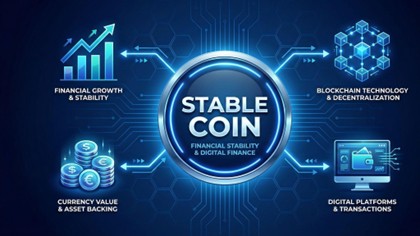
Stablecoins represent a familiar asset, the USD, technologically enhanced for the digital age. By utilizing blockchain technology as the settlement layer rather than a speculative asset, the USD can now be rapidly transacted 24/7/365 on enabling telecommunication infrastructure anywhere across the globe for less than a penny in transaction fees. We are witnessing the Transmission Control Protocol/Internet Protocol (TCP/IP) moment for money with a new settlement protocol that is fast, cheap, and invisible.
Circle and the New Treasury Guard
The most significant shift in the last 180 days has been balance sheet driven. Stablecoin issuers have become some of the leading purchasers and holders of U.S. Treasuries through their minting of stablecoins. Stablecoin issuers receive USD and electronically issue stablecoin tokens. USD received by the stablecoin issuer is used to purchase U.S. Treasuries to back the $1 net asset value (NAV) of the stablecoin much like a traditional money market fund. Circle Internet Group (NYSE: CRCL),the second largest stablecoin issuer by market capitalization with its USDC token behind Tether and its USDT, has become one of the largest U.S. Treasury holders, with roughly $66 Billion in notional value on their balance sheet.
This has been a calculated, strategic absorption of U.S. debt issuance that has been enabled in part by U.S. government policies. As traditional foreign buyers, like China and Japan, have moderated their appetite for U.S. paper, the stablecoin industry has stepped in as a permanent, programmatic buyer. This is effectively the strategic plan of the United States Treasury under Secretary Bessent: ensuring USD hegemony by turning worldwide digital transactions into a demand-sink for U.S. debt.
The Fidelity Stablecoin: TradFi Moves In
For years, traditional finance (known in the crypto world as TradFi) institutions viewed stablecoin companies as upstart competitors. That sentiment has seemingly undergone a total reversal. The launch of the Fidelity Digital Dollar (FIDD) marks the definitive crossing of the Rubicon.
Fidelity Digital Dollar℠(FIDD) is not simply a competing stablecoin, Fidelity has built a vertically integrated financial stack within their brokerage, custodial, and investment platform. FIDD is issued by Fidelity Digital Assets, National Association, a federally chartered trust bank. FIDD is a 1:1 USD-backed stablecoin announced on January 28, 2026, designed for both institutional and retail investors. FIDD operates on the Ethereum network and is backed by cash and short-term U.S. Treasuries. FIDD brings with it Fidelity’s sterling reputation as a bank-grade fiduciary with institutional audits, and its legacy trust and institutional credibility to the digital dollar.
The goal for Fidelity, and the wave of institutions that will follow them, is to make sure their customers stablecoin usage is seamless and easy. With FIDD, customers/users can transact in digital dollars without ever needing to interact with the underlying blockchain infrastructure. Much like the average consumer doesn’t understand the Society for Worldwide Interbank Financial Telecommunication (SWIFT) messaging system for bank wires or Automated Clearing Housing (ACH) batching for electronic funds transfers, the FIDD, USDC, or USDT stablecoin holder will simply enjoy the benefits of instant settlement without needing to manage a private key.
THE GENIUS Act: From Token to Legal Tender
The catalyst for this institutional ramp of stablecoin usage was the signing of the GENIUS Act. This legislation was the green light that hedge funds, investment management firms and corporate boardrooms across the country were waiting for.
The GENIUS Act achieved three critical objectives:
- Legal Finality: It officially designates “Payment Stablecoins” as federally legalized payment instruments rather than unregulated securities.
- 1:1 Mandate: It mandated that all U.S. regulated issuers must back their token 1:1 with cash or short-term Treasuries. This effectively turned every stablecoin into a liquid buffer for the U.S. Treasury market. Circle’s USDC and Fidelity’s FIDD are subject to U.S. regulations and the 1:1 Mandate, but Tether’s USDT is not.
- Bank-Grade Oversight: It provided a pathway for firms like Circle to operate with the same legal certainty as a traditional depository institutions.
By regulating the stablecoin industry, the U.S. government has ensured that the next generation of global trade and transactions happens under the watchful eye of U.S. regulators and in support of the USD as the global reserve currency.
The Efficiency Dividend: The Death of The Wait
In the TradFi world, “T+2” (two-day settlement) is the norm. When you sell a stock or send an international wire, your money sits in a digital purgatory for 48 to 72 hours. This is “trapped capital”, billions of dollars in aggregate that cannot be used, reinvested, or moved. Earning nothing while the transaction moves to the settlement layer.
Stablecoins collapse this latency to near zero.
- Corporate Treasury or Hedge Fund: A multinational corporation or hedge fund can now move $500 million from a subsidiary in Tokyo to its headquarters in Chicago on a Sunday night at 2:00 AM, and have those funds settled and ready for investment when U.S. markets open that morning.
- Consumer Retail: We are also seeing companies like Visa invest in this stablecoin architecture. Visa and a company called Bridge are developing stablecoin-linked cards that allow users to spend directly from their personal non-custodial crypto wallets like Metamask or Phantom.
The technology allows the merchant to get paid instantly via stablecoin settlement protocols, while the consumer enjoys the flexibility and convenience of using their digital-native wallet. This removes the costly 3% middleman transaction toll that has burdened global commerce for decades.
The Future of Global Trade
If you follow the logic of the GENIUS Act and the strategic stance of the U.S. government, the future of the financial system becomes much clearer. We are moving toward a global programmable USD and USD backed settlement layer for global trade and finance.
The next phase of this evolution will utilize smart contract integrated finance. Imagine a supply chain where a payment is automatically triggered the moment a shipping container hits a specific delivery port and the barcode or QR code is scanned. There is no invoicing, no bank wire to authorize, and no 3-day wait times. The stablecoin just flows through the digital contract the moment the conditions are met. Talk about working capital and investment efficiencies.
The strategic plan is to make USD the easiest, fastest, and most programmable currency in the world. This ensures that no other currency can compete for global reserve status for the foreseeable future.
Bottom Line for Servant Financial Clients
Our investment focus remains anchored in the underlying infrastructure of this transition, moving past the speculative token era and into an era defined by capturing the efficiency of the stablecoin settlement rails and network architecture. We anticipate that Circle’s market share will continue to outpace offshore competitors like Tether as transaction volume shifts towards regulated, institutional channels and the clarity and comfort of the GENIUS regulatory framework. Beyond mere volume, Circle’s status as a U.S.-based entity provides unique leverage and has effectively positioned the company as the preferred domestic partner for the U. S. government as it seeks to modernize domestic and international financial and monetary systems. We viewed CRCL as a higher risk, opportunistic strategy and only added it selectively to more risk tolerant models earlier this year – Core-Satellite Moderate and Core-Satellite Aggressive and similar bespoke client models. CRCL is up roughly 17% in price year-to-date through March 28, 2026 compared to an approximate (8%) decline for the S&P 500 index.
“Stablecoins represent a revolution in digital finance. The dollar now has an internet-native payment rail that is fast, frictionless, and free of middlemen.”
~ Secretary of the Treasury Scott Bessent.